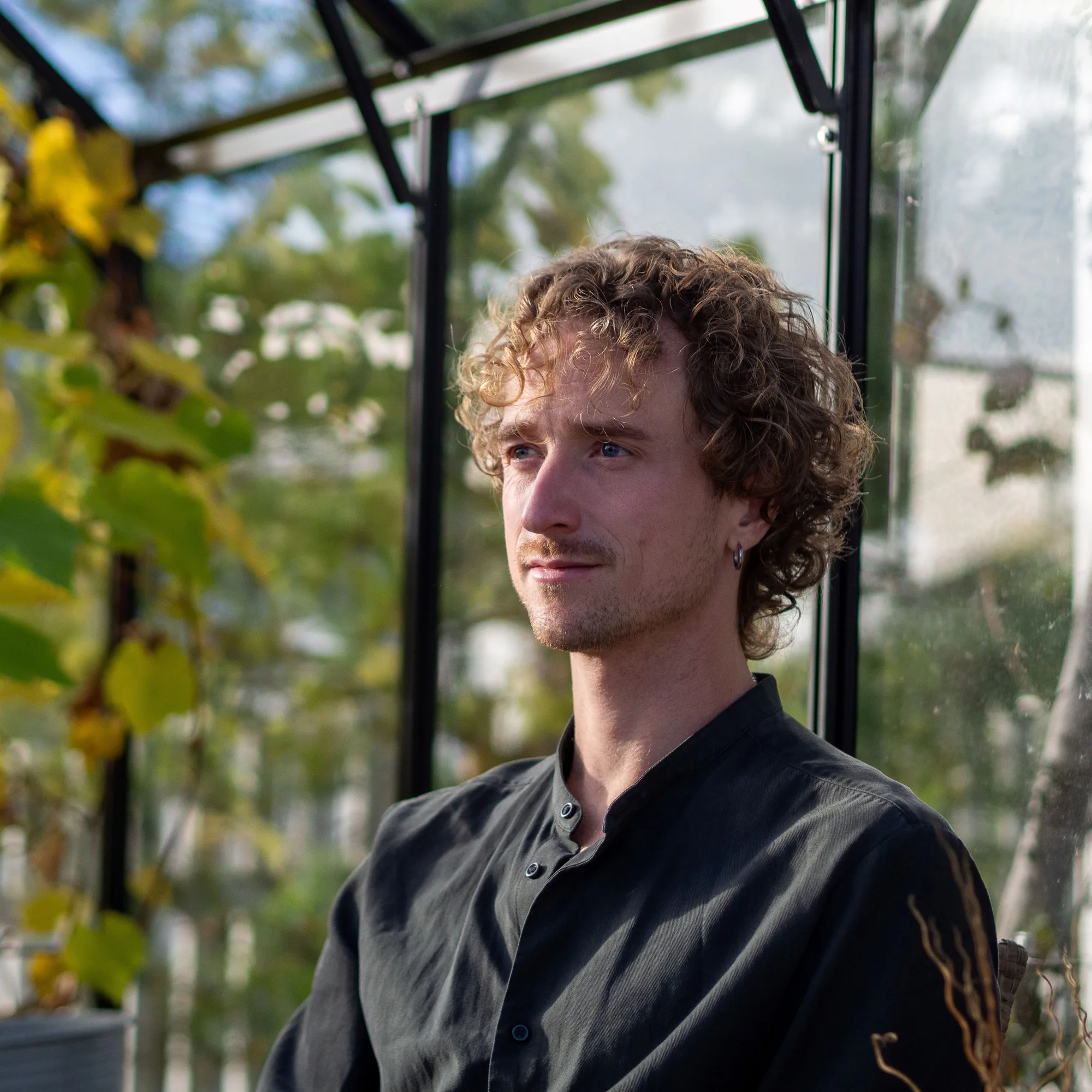
Simon H.J.
Bjørkå Flatin
I am an architect. MSc and ir. from TU Delft, Architecture, Urbanism and Building Sciences, graduated cum laude in 2023.
I grew up in Larkollen, outside Oslo, with a view over the fjord. In the woods behind the house there was a small hidden pond that changed slowly through the year, and watching it is where my interest in time began, time as something buildings live inside rather than resist. That interest ran through my graduation project, Arctic Symphony, an Explore Lab thesis sited on a wild stretch of river in Alta.
Before Delft I spent an exchange year at La Trobe University in Melbourne and studied technical design at Noroff in Oslo. Alongside my studies I worked nine years at Ebano AS, designing restaurants, bars and cafés with a focus on commercial kitchens, from layout through to custom stainless steel products, and later running planning and logistics for a house build. I interned at Lüchinger Architects in Rotterdam on the transformation of a historic barn at Oud Alblas, and I was commissioned by the dean at TU Delft to build two architectural models of Ethiopian buildings, one of which was shown at the Venice Architecture Biennale in 2023. That same year our collective Bounding Box shared first place in the Upcycle Mall Rotterdam competition with Harbour Box, a proposal built from waste materials off the Rotterdam docks. I also co-founded Alternative Realities, a small research collective looking at how architecture and urban space can develop alongside natural processes. It is no longer active.
I have run my own practice since 2023, registered as Bjørkå Flatin ENK in 2025. I split my time between Norway and São Paulo and work mostly online, with clients in Norway, Sweden, Portugal, the United States and Brazil. The work runs from a planning application for a care building, through competition proposals, to architectural visualisation.
I also build software for the industry I work in. Tinn is a specification tool for the built environment and hytteboka.app is an app for cabin owners. Both are running. Most projects, though, still start with a physical model on the desk.